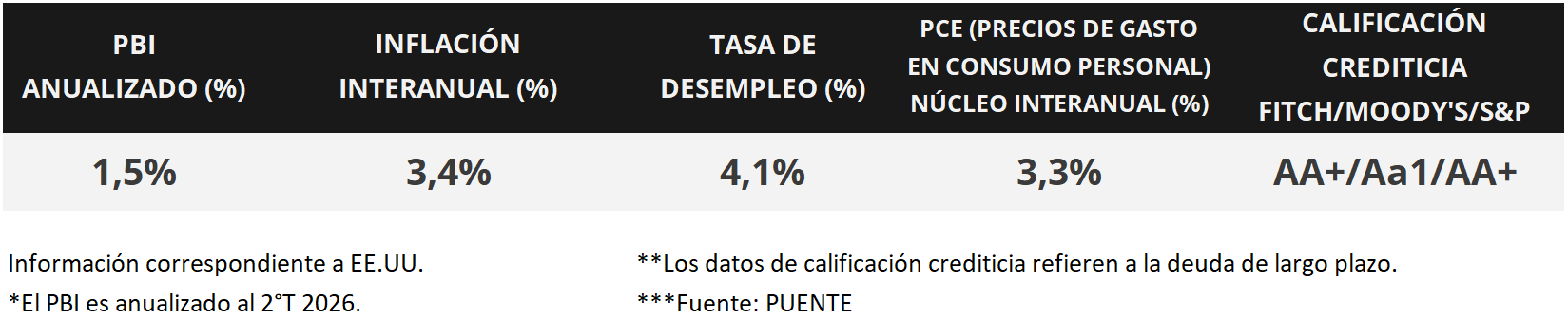
In the United States, the Personal Consumption Expenditures (PCE) price index—the Federal Reserve's (Fed) benchmark for inflation and interest rate decisions—rose to 3.3% year-over-year in July, excluding food and energy, in line with expectations. At the Jackson Hole Economic Symposium, Fed Chairman Warsh left open the possibility of a potential interest rate hike if inflation data does not improve. Against this backdrop, the US Treasury yield curve showed mixed performance this week, with the 1-year Treasury yield widening to 4.13% and the 10-year yield slipping slightly to 4.72%. This week, the focus will be on the August labor market data, with expectations of 60,000 new jobs created and an unemployment rate of 4.2%. The short-term outlook is for inflation above the central bank's target (2.0%) and a resilient labor market, which would keep the benchmark interest rate (currently in the 3.5%-3.75% range) at historically high levels. This allows for higher nominal returns for longer periods on investment-grade bonds, with maturities up to five years being particularly attractive.
Monitor Semanal
Internacional
This week in the United States, attention will be focused on the August labor market data, ahead of the Fed's next meeting in mid-September. Projections indicate the creation of 60 new jobs and an unemployment rate of 4.2%. The July trade balance will also be released, while the world awaits any developments regarding the geopolitical conflict. In the Eurozone, preliminary August inflation figures will be published, with an estimated year-on-year increase of 3.2% and core inflation of 2.5%. Retail sales figures—a proxy indicator of economic activity—will also be released for July. Finally, Brazil will publish its second-quarter GDP figures, with expectations of 1.8% year-on-year growth.
At the Jackson Hole symposium, which brings together the world's central bankers annually, Federal Reserve Chairman Kevin Warsh reaffirmed the 2.0% medium-term inflation target, while also considering the possibility of an interest rate hike if inflation data does not improve. Consequently, the probability of a Fed rate increase in September rose from 30% to over 50%.
In the United States, PCE inflation—the Fed's preferred indicator for monetary policy decisions—rose 0.2% month-on-month and 3.7% year-on-year in July, exceeding analysts' consensus estimates. Core inflation also increased 0.2% month-on-month and 3.3% year-on-year, in line with expectations. Meanwhile, second-quarter GDP growth was 1.5% annualized, according to the second of three projections, consistent with forecasts.
Regarding the second-quarter earnings season, Nvidia—one of the "Magnificent Seven"—reported its results, with earnings per share (EPS) of $2.22 and revenue of $96.22 billion, exceeding expectations. The season is nearing its end, as 97% of S&P 500 companies have now released their earnings reports. Of these, 86% surpassed earnings estimates and 77% exceeded revenue estimates. Overall, earnings are up 52.0% year-over-year and revenue is up 15.5%, both exceeding estimates.
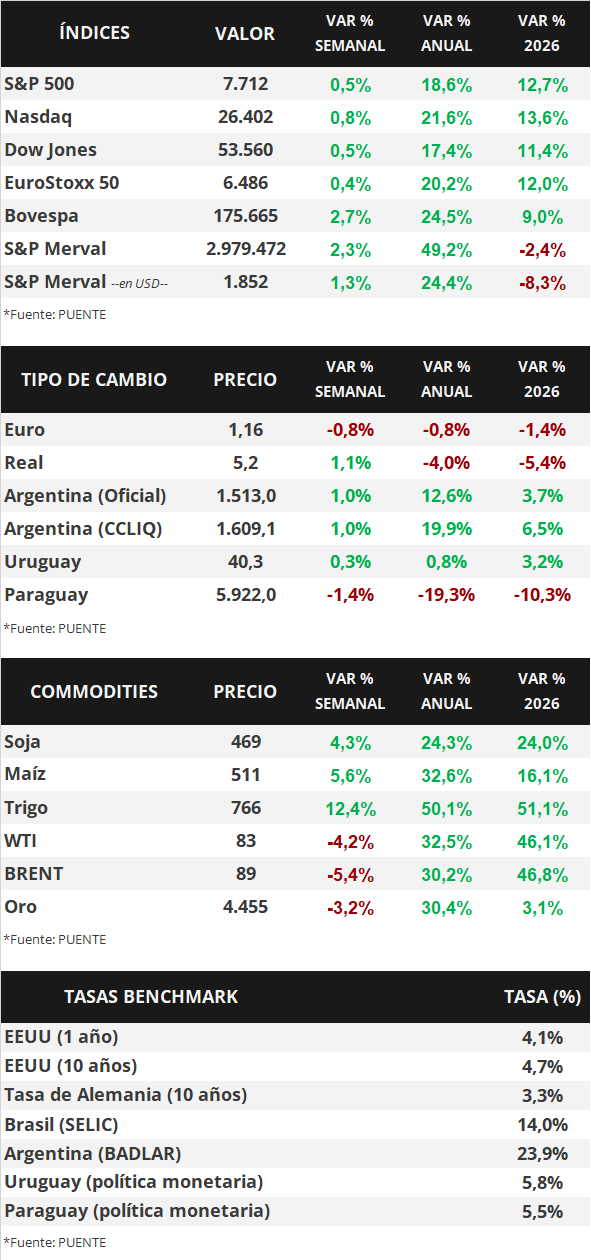
Against this backdrop, the US Treasury yield curve traded mixed, with short- and medium-term bonds widening and long-term bonds narrowing during the week. Thus, the 1-year bond yield rose from 4.01% to 4.13%, the 3-year yield from 4.31% to 4.41%, and the 10-year yield from 4.73% to 4.72%. Meanwhile, investment-grade corporate bonds (LQD ETFs) closed with an average yield of 5.8%. Elsewhere, the main US stock indices finished positive, with the Nasdaq leading the way with a weekly gain of 0.8%.
In Latin America, Mexico released its Q2 GDP data, which showed an expansion of 2.1% year-on-year and 1.4% quarter-on-quarter, slightly below analysts' consensus forecasts but above the performance of the previous quarter. Against this backdrop, the benchmark stock index fell 0.4% week-on-week.