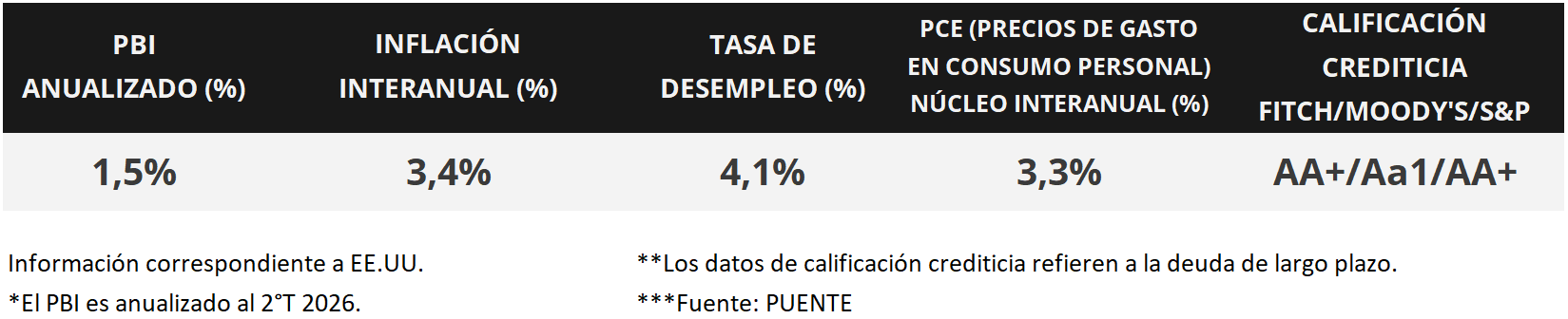
In the United States, the minutes from the Federal Reserve's July meeting, in which the benchmark interest rate was kept in the 3.5%-3.75% range, revealed a willingness to tighten monetary policy if inflation does not subside. Despite maintaining the pause, many officials expressed concern about inflationary pressures, exacerbated by the prolonged geopolitical conflict in the Middle East. Against this backdrop, the yield curve for US Treasury bonds broadened across all maturities, with the 1-year Treasury yield at 4.01% and the 10-year yield at 4.73%. This week, attention will be focused on the Jackson Hole Symposium, where leading central bank governors meet annually to discuss monetary policy and the direction of the global economy. The July Personal Consumption Expenditures (PCE) price index—the Federal Reserve's preferred indicator for interest rate decisions—will also be released, with an estimated 3.3% increase in the excluding food and fuel (energy) measurement. Regarding earnings season, Nvidia will be the last of the "Magnificent Seven" to report its results. The short-term outlook is for inflation above the Fed's target of 2.0% and a resilient labor market, which would lead to the benchmark interest rate remaining at historically high levels. Consequently, this allows for higher nominal returns for longer on investment-grade bonds, with the up to five-year maturity segment of the yield curve being particularly attractive.
Weekly Monitor
International
This week's focus in the United States will be on the Jackson Hole Symposium, an annual convention that brings together leading central bankers in Wyoming to discuss monetary policy and the challenges of the global economy. Meanwhile, the PCE inflation figure—the Fed's benchmark for monetary policy decisions—for July will be released, projected to rise 3.6% year-over-year, and core inflation 3.3%. The second estimate of Q2 GDP will also be released, with an expected annualized growth rate of 1.5%. Regarding the Q2 earnings season, Nvidia will be the last of the "Magnificent Seven" to report its results. In Latin America, Mexico will release its Q2 GDP figures, with annualized growth estimated at 2.2%.
The minutes from the Fed's last meeting, in which the interest rate was left unchanged in the 3.5%-3.75% range by a split decision, revealed that several committee members believe a tightening of financial conditions can steer inflation toward its medium-term target of 2.0%, avoiding more pronounced and costly measures later on. They also noted that the outlook for price developments is uncertain given the ongoing conflict in the Middle East.
In other news, preliminary August PMIs—leading indicators of economic activity—all came in above 50, indicating economic expansion. While the manufacturing PMI reached 53.2, slightly below projections and the previous month's reading, the services PMI and the composite PMI registered 56.8 and 56, respectively, exceeding expectations.
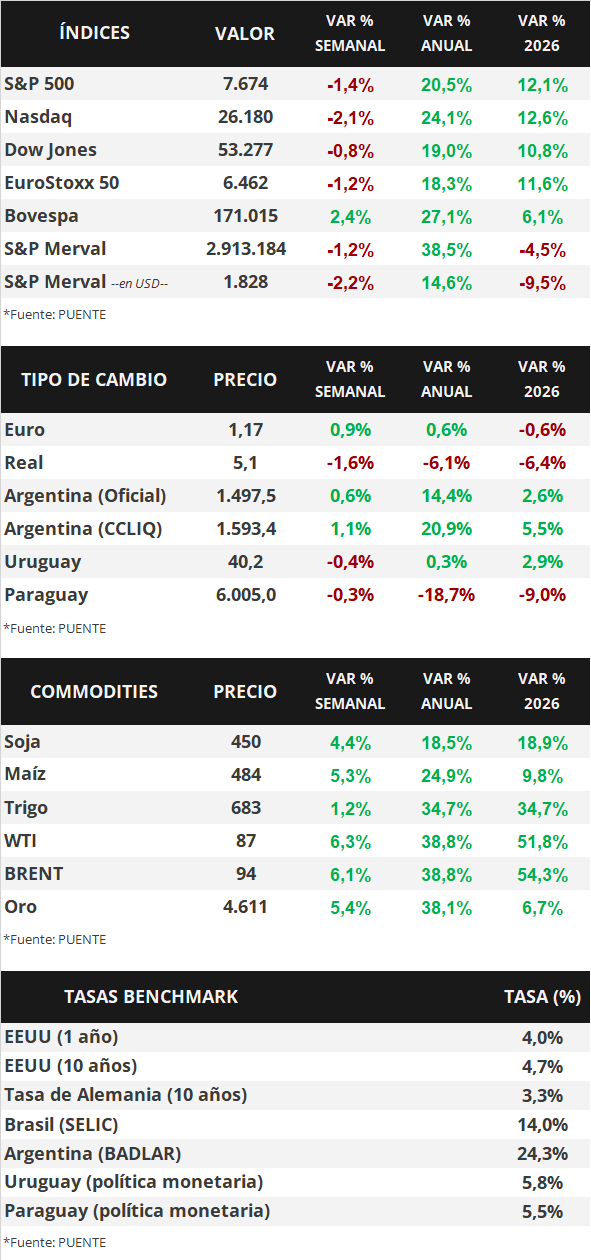
In this environment, US Treasury yields widened across all maturities during the week, primarily in the short and medium ends of the curve. The 1-year Treasury yield rose from 3.96% to 4.01%, the 3-year yield from 4.24% to 4.31%, and the 10-year yield from 4.69% to 4.73%. Meanwhile, investment-grade bonds (LQD ETFs) closed with an average yield of 5.9%. Finally, the main US stock indices posted negative performance, with the Nasdaq being the hardest hit at -2.1% for the week.
In the Eurozone, July inflation was in line with analysts' consensus estimates, registering +0.2% month-on-month and +2.9% year-on-year, slightly above June's figures. Core inflation remained unchanged month-on-month, while it rose 2.5% year-on-year. Meanwhile, preliminary August PMIs also exceeded 50 points across the board, with manufacturing at 52.8 points and services at 51.7 points. Against this backdrop, the euro rose 0.9% to $1.17 per euro, while the yield on the 10-year German Treasury bond closed at 3.26%.
Regarding the performance of Latin American sovereign debt, the yields on 10-year dollar-denominated bonds in Brazil and Mexico fell from 6.45% and 6.14% at the beginning of the previous week to their current levels of 6.40% and 6.13%, respectively.