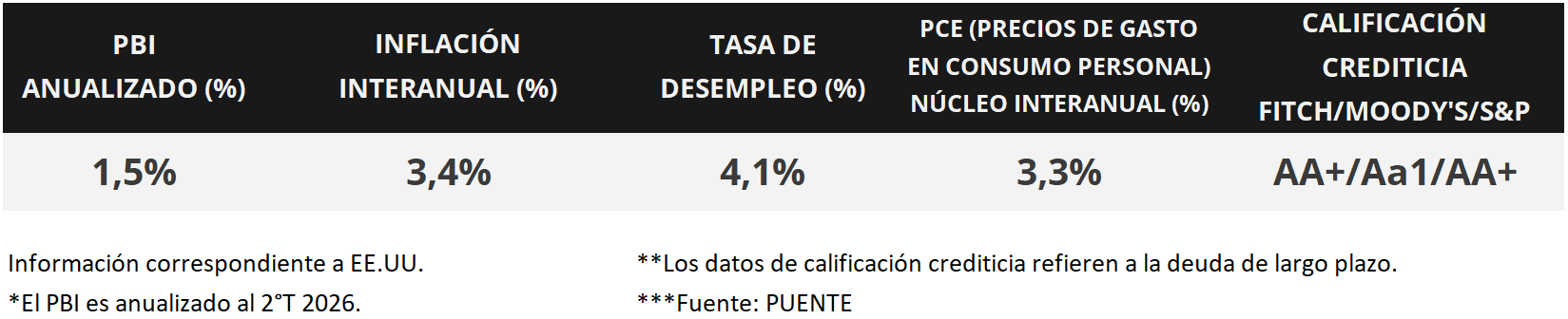
In the United States, the August Consumer Price Index largely aligned with analyst consensus expectations, recording a year-over-year increase of 3.4%—and 2.4% for the core measure excluding food and energy. Meanwhile, wholesale inflation for the period stood at 5.4% year-over-year (4.6% core), with both figures exceeding July's levels. Against this backdrop, the U.S. Treasury yield curve steepened across the board during the week; the 1-year bond yield settled at 4.32% and the 10-year bond at 4.97%. Attention this week will focus on the Federal Reserve (Fed) meeting, where the benchmark rate is projected to remain unchanged within the 3.50%–3.75% range. Additionally, the Fed will release its quarterly update on macroeconomic outlooks and the projected interest rate path. This will be significant for the coming months, given that inflation remains above the central bank's 2.0% target and the labor market remains resilient—factors likely to keep interest rates at historically high levels. This environment allows for sustained high nominal yields on investment-grade bonds, making the curve segments with durations of up to five years particularly attractive. Separately, the European Central Bank raised its benchmark rate by a quarter percentage point to 2.65%, amid persistent inflationary pressures.
Weekly Monitor
International
Attention in the United States this week will focus on the Fed's monetary policy meeting, with expectations that the benchmark rate will remain unchanged within the current 3.5%–3.75% range. The central bank will also present its quarterly update on economic outlooks and the projected interest rate path. Additionally, data on retail sales—a proxy for economic activity—and industrial production for August will be released. In Europe, final inflation figures for the Eurozone for August are due, with a year-on-year rise of 3.3% projected for headline inflation and 2.4% for core inflation. Monetary policy meetings are also scheduled in other countries. In the UK, borrowing costs are expected to remain unchanged at an annual rate of 3.75%; in Japan, a tightening of monetary policy is anticipated, with a rate hike to 1.25% from the current 1.0%; and in Brazil, a further easing of the Selic rate to 13.75% from the current 14% is expected.
In the United States, the August Consumer Price Index (CPI) came in largely in line with expectations. Specifically, it rose 0.4% month-on-month and 3.4% year-on-year, while the core measure recorded a 0.3% monthly and 2.4% annual increase. It is worth noting that the monthly figures showed acceleration compared to July. Following the release of this data, Fed interest rate futures are pricing in a 90% probability of a quarter-percentage-point hike in the benchmark rate at this week's meeting.
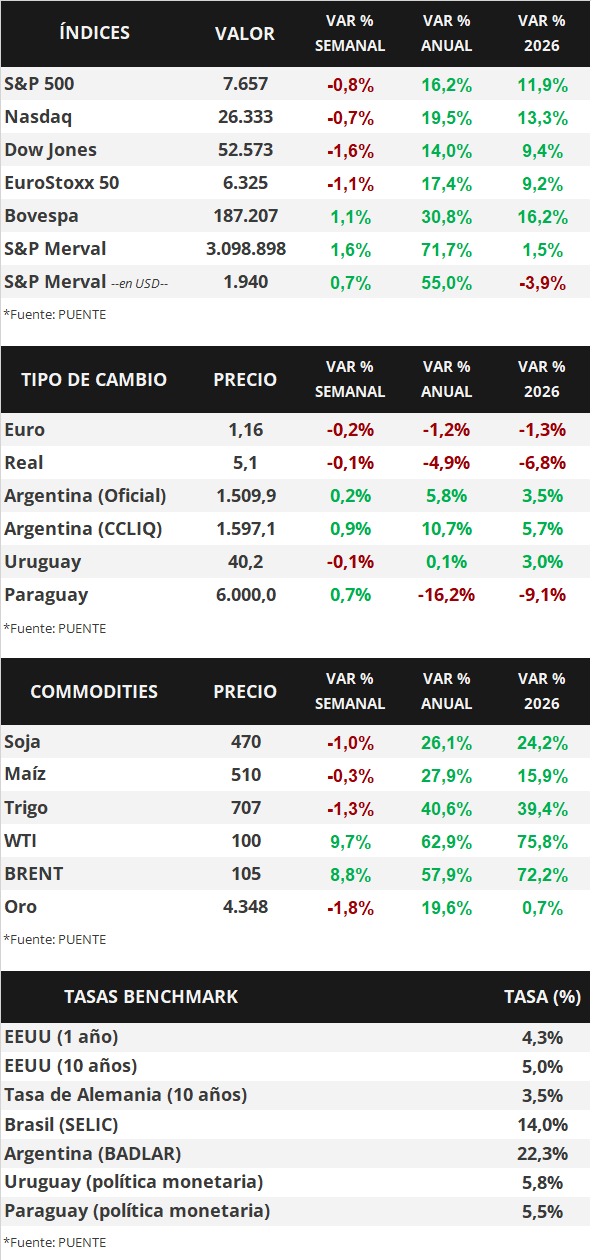
Meanwhile, wholesale inflation for August rose 0.4% month-on-month and 5.4% year-on-year—surpassing the forecast of 5.3%—reflecting an acceleration compared to July. The core measure rose 0.2% month-on-month and 4.6% year-on-year. Against this backdrop, US Treasury yields rose over the week, particularly along the short and intermediate segments of the curve. Specifically, the yield on the 1-year bond climbed from 4.11% to 4.32%, the 3-year bond from 4.45% to 4.72%, and the 10-year bond from 4.78% to 4.97%. Meanwhile, investment-grade corporate bonds (LQD ETF) reached an average yield of 6.1%. Separately, major US stock indices closed lower, with the Dow Jones taking the biggest hit, falling 1.6% for the week.
The European Central Bank (ECB) once again raised its benchmark rate—this time to 2.65% from the previous 2.4%, in line with expectations—amidst inflation levels that have remained persistently above the 2.0% target for an extended period due to the impact of the war in the Middle East. However, final second-quarter Gross Domestic Product (GDP) data showed growth of 1.2% year-over-year, surpassing the estimated 1.0% and reflecting the bloc's resilience. Against this backdrop, the euro fell 0.2% over the week to 1.16 dollars per euro.
In Latin America, August inflation figures were released for Brazil, Mexico, and Chile. While Brazil’s inflation rose 4.2% year-over-year—lower than expected and below July's performance—rates in Mexico and Chile came in slightly higher than in July, recording annual increases of 3.3% and 4.1%, respectively. Notably, consistent with price levels exceeding projections, the Central Bank of Chile kept interest rates unchanged at 4.5%. Consequently, exchange rates saw weekly movements of -0.1% in Brazil, +0.5% in Mexico, and +0.9% in Chile.