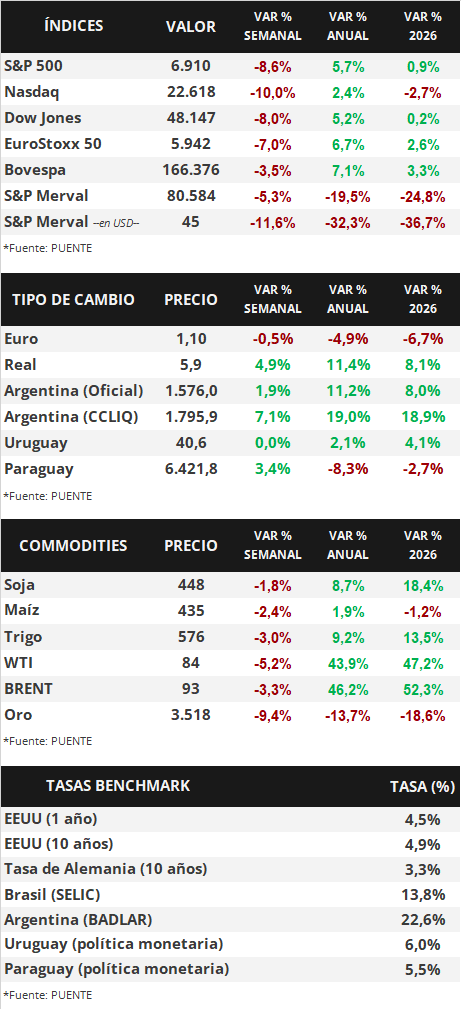
The minutes from the Federal Reserve’s (Fed) October meeting revealed that most members of the monetary policy-making committee agree that another interest rate hike—with rates currently in the 3.75%–4.0% range—will be necessary in the coming months to mitigate inflationary pressures and steer inflation back toward the Fed’s target. Against this backdrop, the U.S. Treasury yield curve flattened across all maturities over the week, with the 1-year note yielding 4.48% and the 10-year note at 4.93%. This week, the Personal Consumption Expenditures (PCE) price index for October—the Fed’s preferred gauge for monetary policy decisions—will be released; expectations point to a year-over-year increase of 3.8%, or 3.2% when excluding food and energy (the core measure). Additionally, the second estimate of third-quarter Gross Domestic Product (GDP) will be published, with growth projected at an annualized rate of 3.4%. In the near term, inflation remains above the long-term target (2.0%), and the labor market continues to show resilience—factors that are likely to keep interest rates at historically high levels. This environment supports sustained, high nominal yields for investment-grade bonds, with the portion of the yield curve covering maturities of up to five years appearing particularly attractive.
Weekly Monitor
International
The focus in the United States this week will be on the release of the October PCE inflation data—the Fed’s preferred indicator for interest rate decisions—with a year-over-year increase of 3.8% projected, and 3.2% for the core measure. Meanwhile, the second estimate of third-quarter GDP will be released, with an annualized growth rate of 3.4% anticipated. Additionally, preliminary November Purchasing Managers' Index (PMI) data for various sectors, compiled by S&P Global, will be published for both the United States and the Eurozone. Finally, Mexico will release its third-quarter GDP figures, which are expected to show a 3.1% year-over-year increase.
The minutes from the Fed’s October monetary policy meeting—during which the benchmark interest rate was held steady in the 3.75%–4.00% range—revealed that most committee members agree on the need for an additional interest rate hike in the coming months to curb inflation and bring it closer to the central bank’s long-term target.
Separately, U.S. retail sales—a proxy for economic activity—slowed for the second consecutive month in October, posting a 0.2% monthly increase and a 6.8% year-over-year gain. Meanwhile, industrial production for the same month fell by 0.4%—missing the consensus expectation of a neutral outcome—though it rose 2.1% on a year-over-year basis.
Regarding the third-quarter corporate earnings season, Nvidia—the last of the "Magnificent Seven" to report—released its results this week. In this regard, it reported earnings per share of USD 2.68 and revenue of USD 115.8 billion, surpassing expectations of USD 2.47 and USD 108.85 billion, respectively.
Against this backdrop, U.S. Treasury yields compressed over the week. The 1-year Treasury note fell from 4.59% to 4.48%, the 3-year note from 4.91% to 4.67%, and the 10-year benchmark from 5.14% to 4.93%. Meanwhile, investment-grade corporate bonds (tracked by the LQD ETF) closed with an average yield of 6.3%. Separately, major U.S. stock indices trended downward, with the Dow Jones posting the smallest decline (-8.0%).
In the Eurozone, inflation accelerated in October. Specifically, it rose by 0.5% month-on-month and 4.0% year-on-year, while core inflation increased by 0.3% month-on-month and 2.6% year-on-year—surpassing the 2.5% projected by the analyst consensus. Given this landscape, the euro fell 0.5% over the week to 1.10 dollars per euro, while the yield on the 10-year German government bond retreated to 3.30%.