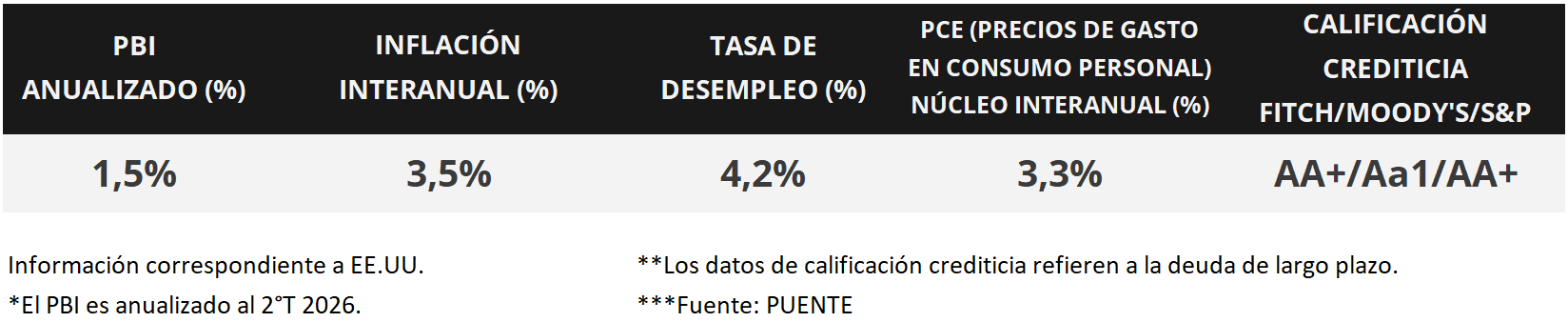
In the United States, 23,000 jobs were lost in July, contrary to the 85,000 new jobs projected by analysts and the revised June figure of 20,000. Nevertheless, the unemployment rate stood at 4.1%, its lowest level in over a year and slightly below expectations. Against this backdrop, major US stock indices closed higher, with the S&P 500 and the Dow Jones reaching new all-time highs. Meanwhile, US Treasury yields compressed across the curve, with the 1-year Treasury yield at 3.99% and the 10-year yield at 4.64%. This week, attention will be focused on the release of the July Consumer Price Index, with expectations of a 3.4% year-over-year increase and a 2.5% increase for the core inflation (excluding food and energy) index. Meanwhile, wholesale inflation for the same month will be released, while the second-quarter corporate earnings season continues. The short-term outlook features inflation above the central bank's target of 2.0% and a stable labor market, resulting in historically high interest rates. This allows for higher nominal returns on investment-grade bonds over a longer period, with bonds with maturities up to five years being particularly attractive.
Weekly Monitor
International
This week's focus in the United States will be on the July retail inflation data, with an annual increase of 3.4% and a 2.5% increase in core inflation. The wholesale price index and retail sales figures—a proxy for economic activity—for July will also be released. In the Eurozone, the second estimate of Q2 GDP will be published, with year-on-year growth expected at 1.0%, along with June's industrial production figures. Finally, Brazil will release its July inflation data, with the latest figure showing a 4.6% annual increase.
In the United States, 23,000 jobs were lost in July, bucking the positive trend of job creation seen over the previous four months. This result contrasted sharply with the 85,000 new jobs estimated by analysts and the revised June figure of 20,000 (down from 57,000). Meanwhile, the unemployment rate stood at 4.1%, compared to the expected 4.2%, the lowest level since June 2025, partly due to lower labor force participation.
Regarding the second-quarter earnings season, 88% of S&P 500 companies have now released their financial results. Of these, 86% exceeded earnings estimates and 76% exceeded revenue estimates. Overall, earnings are up 50.4% year-over-year and revenue is up 15.0%, both above estimates. This week, Palantir, Caterpillar, HSBC, Merck & Co., Pfizer, Booking.com, CVS Health, Uber Tech, Mercado Libre, Motorola, and Siemens reported EPS and revenue above expectations. McDonald's, Kimberly-Clark, and Walt Disney, on the other hand, only exceeded their EPS projections, but not their revenue projections. Meanwhile, Toyota Motors and Allianz reported lower-than-expected earnings per share (EPS) and revenue.
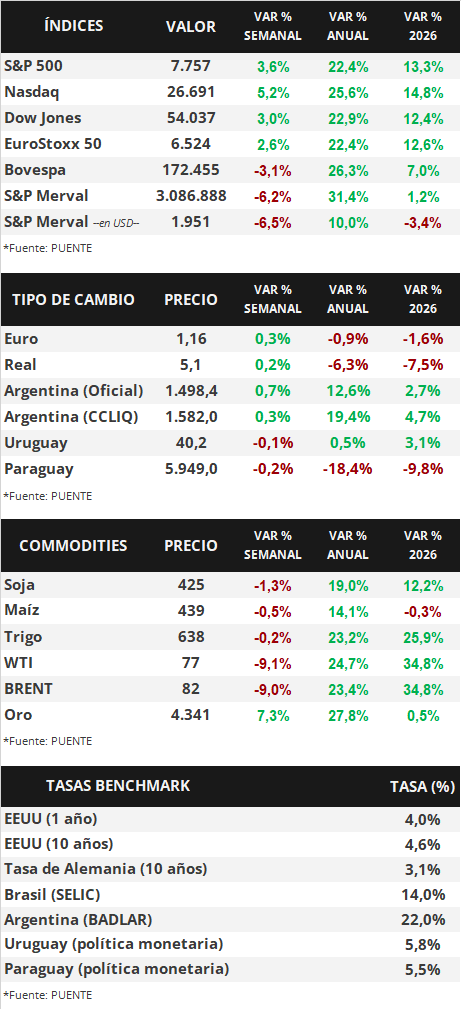
Against this backdrop, US Treasury yields compressed across the entire curve during the week. The 1-year Treasury yield fell from 4.03% to 3.99%, the 3-year yield from 4.35% to 4.26%, and the 10-year yield from 4.73% to 4.64%. Investment-grade corporate bonds (LQD ETFs) finished with a yield of 5.8%. Finally, the main US stock indices closed higher, with the S&P 500 and the Dow Jones reaching new all-time highs.
In Latin America, the Central Bank of Brazil decided to reduce its monetary policy rate for the fourth consecutive meeting, lowering it to 14.0% annually from the previous 14.25%, in line with expectations. Meanwhile, in Mexico, the monetary authority maintained the benchmark interest rate at 6.5%. Separately, July inflation figures were released for Mexico and Chile, showing annual increases of 3.1% and 3.5% respectively, the latter slightly lower than projected.