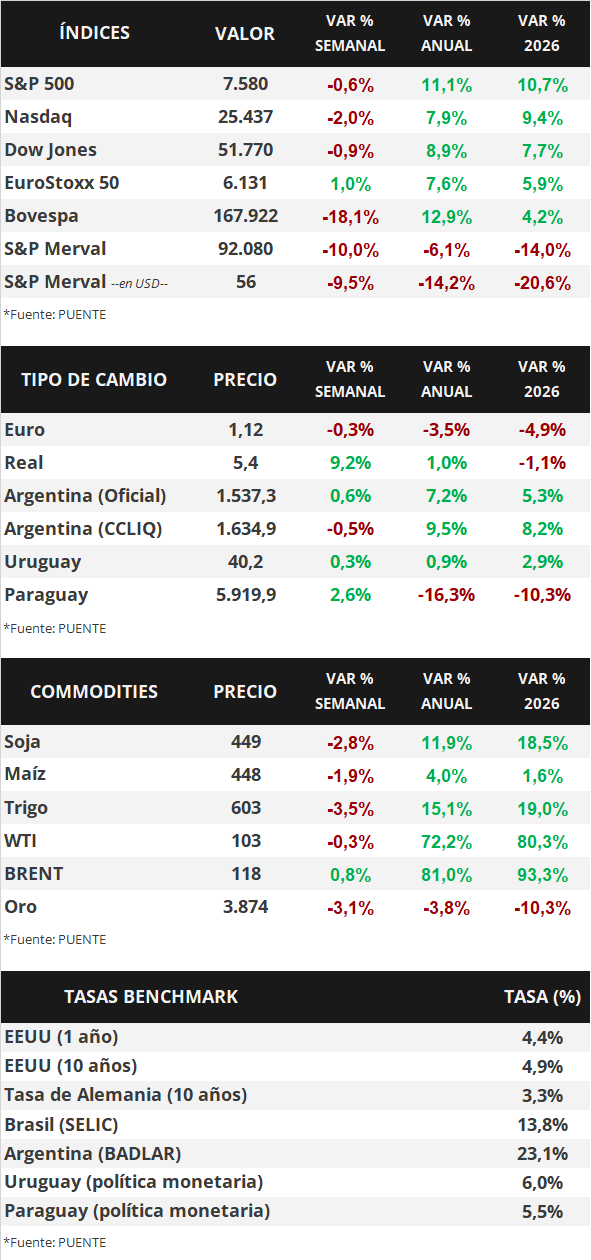
The U.S. Federal Reserve (Fed) kept its benchmark interest rate unchanged in the 3.75%–4.00% range—in line with expectations—as part of its efforts to achieve price stability. Separately, the Personal Consumption Expenditures (PCE) price index for September—the Fed’s preferred inflation gauge for monetary policy decisions—was released, showing a 3.1% increase in its "core" measure (excluding food and energy), which matched forecasts. Meanwhile, third-quarter Gross Domestic Product (GDP) grew at an annualized rate of 3.4%, surpassing projections. Against this backdrop, the U.S. Treasury yield curve flattened across the board during the week, with the 1-year note yielding 4.37% and the 10-year note at 4.93%. This week, attention will focus on the release of October labor market data, with projections pointing to the creation of 60,000 new jobs and an unemployment rate of 4.2%. On the political front, the midterm elections will take place, which will determine the composition of Congress moving forward. In the short term, the outlook suggests that inflation will remain above the Fed’s 2.0% target, while the labor market is expected to remain resilient—a combination likely to keep interest rates at historically high levels. This environment allows for higher nominal yields over a longer period for investment-grade bonds, with the portion of the yield curve representing maturities of up to five years appearing particularly attractive.
Weekly Monitor
International
In the United States, the focus this week will be on the release of labor market data for October, with an estimated 60,000 new jobs created and an unemployment rate of 4.2%. Additionally, the midterm elections will take place, which will determine the new composition of Congress. Meanwhile, the third-quarter corporate earnings season continues, with particular attention on the report from Apple—one of the "Magnificent Seven." In the Eurozone, preliminary inflation data for October will be released, with expectations of a 3.9% annual increase (and 2.5% for core inflation), alongside retail sales figures for September, which serve as a proxy for economic activity. In the United Kingdom, monetary policy meetings are scheduled, with projections pointing to an increase in the benchmark interest rate from the current 3.75% to 4.0%. Finally, in Latin America, Brazil and Mexico are set to announce interest rate decisions—with rates expected to remain at their current levels of 13.75% and 6.5%, respectively—while Chile will release its October inflation data.
The Federal Reserve kept its monetary policy rate unchanged within the current 3.75%–4.00% range, in line with the consensus expectations of analysts. The decision—which was not unanimous, as two committee members favored an increase in borrowing costs—was centered on achieving price stability. Nevertheless, the Fed reaffirmed that it will continue to evaluate macroeconomic data ahead of each future decision.
Meanwhile, the Personal Consumption Expenditures (PCE) price index for September—the Fed’s preferred inflation gauge for monetary policy decisions—showed an acceleration, with results that aligned with projections across the board. Thus, it recorded an increase of +0.5% month-on-month and +3.6% year-on-year, while the core measure rose +0.3% month-on-month and +3.1% year-on-year. Regarding economic activity, third-quarter GDP grew by +3.4% (annualized rate)—according to the first of three estimates—surpassing both the +3.2% expected and the performance seen in the second quarter (+2.2% annualized).
As for the third-quarter earnings season, 60% of S&P 500 companies have released their financial results so far. Of these, 82% beat earnings estimates, and 70% surpassed revenue expectations. Overall, earnings have increased by +30.2% year-on-year (higher than anticipated), with the "Magnificent Seven" posting a +22.6% gain, while the remaining 493 companies saw a +30.8% increase—contrary to the trend observed thus far. This week, Microsoft, Visa, Coca-Cola, T-Mobile US, Eli Lilly, Mastercard, Merck & Co., Intel, Caterpillar, AbbVie, and Colgate-Palmolive all reported earnings per share (EPS) and revenue figures that exceeded expectations. Meanwhile, Alphabet beat revenue forecasts but fell short on EPS, and Amazon reported both EPS and revenue figures below expectations. Finally, Verizon, Novartis, PayPal, and Starbucks reported EPS figures that were higher than projected. This week, reports are expected from several major companies, including Apple, Palantir, Pfizer, McDonald's, CVS Health, MercadoLibre, Motorola, Toyota, and Airbnb.
Against this backdrop, yields on U.S. Treasury bonds compressed across the entire yield curve over the course of the week. The 1-year bond yield moved from 4.39% to 4.37%, the 3-year bond from 4.75% to 4.66%, and the 10-year benchmark bond from 4.99% to 4.93%. Meanwhile, investment-grade corporate bonds (LQD ETF) closed with an average yield of 6.2%. Separately, major U.S. stock indices declined over the week, with the S&P 500 posting the smallest drop (-0.6%).
The European Central Bank (ECB) kept its benchmark interest rate unchanged at 2.65% per annum, in line with expectations. The institution noted that inflationary pressures remain a latent risk, although core inflation has recently held steady. Additionally, third-quarter GDP figures were released, showing a 1.3% year-over-year expansion—a better-than-projected result and the strongest performance of the year. Against this backdrop, the euro fell 0.3% for the week to $1.12, while the yield on the 10-year German government bond (Bund) ended at 3.32%.
Furthermore, the Bank of Japan and the Central Bank of Chile held their respective monetary policy meetings. In both cases, benchmark interest rates were left unchanged at 1.25% and 4.5%, respectively.