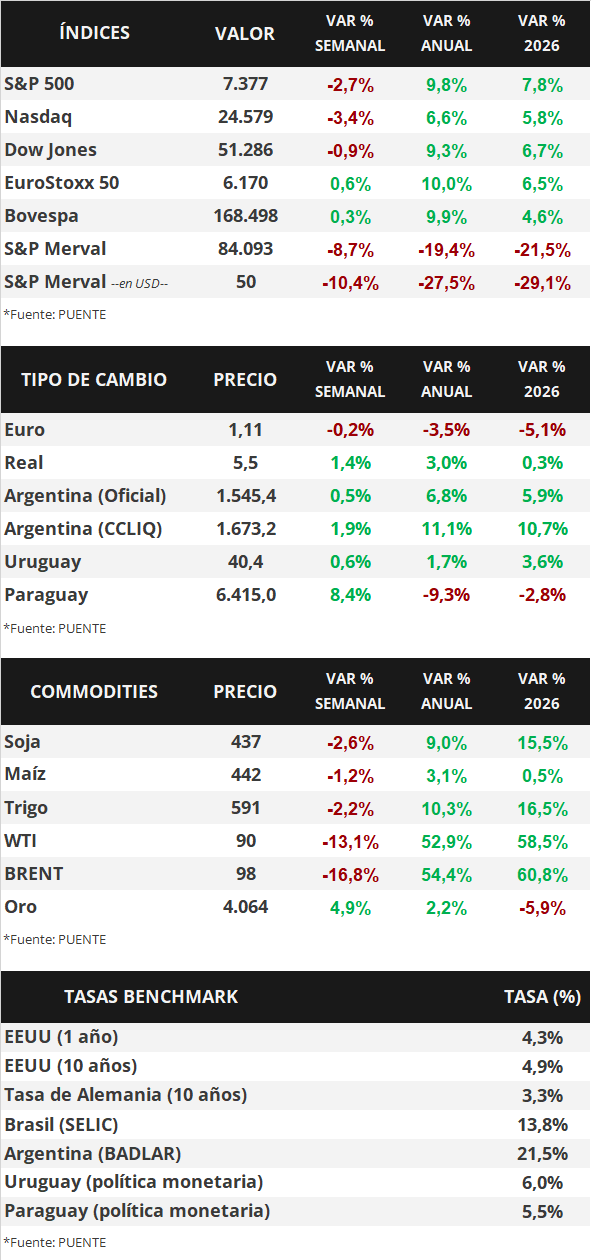
In the United States, 165,000 new jobs were created in October—well above the 65,000 jobs projected and the revised figure of 60,000 for September. Meanwhile, the unemployment rate edged down to 4.1%. On the political front, the Democrats prevailed over the Republicans in the midterm elections, securing control of both chambers of Congress. Against this backdrop, the U.S. Treasury yield curve flattened across the board over the week, with the 1-year note at 4.31% and the 10-year note at 4.86%, while equity indices generally declined. This week, attention will be focused on the release of October inflation data; a monthly increase of 0.3% is expected, with a 0.2% rise in the core measure (excluding food and energy). Looking ahead, the outlook suggests that inflation will remain above the Federal Reserve’s long-term target of 2.0%, accompanied by a resilient labor market—factors likely to keep interest rates at historically high levels. This environment allows for sustained, attractive nominal yields on investment-grade bonds, with the portion of the yield curve spanning maturities of up to 5 years appearing particularly favorable.
Weekly Monitor
International
The focus of the week in the United States will be on the publication of the consumer price index for October, with the expectation being a monthly increase of +0.3% and +0.2% in the core measurement. Likewise, wholesale inflation for the same month will be known, while the business results season for the 3rd quarter continues. In Latin America, October inflation will be released in Brazil, with the latest record being an increase of +4.6%, and in Mexico, for which +3.6% is projected annually.
In the United States, 165 thousand new jobs were created during October, above the projected 65 thousand positions and the revised data for September (60 thousand positions). In this way, it represents the best record of the last six months. Meanwhile, the unemployment rate stood at 4.1%, slightly lower than the 4.2% estimated by the consensus of analysts.
On the political level, the Democratic party prevailed over the Republican party in the midterm elections in the United States, taking control of both chambers of Congress. This new scenario is uncertain due to possible greater regulations and restrictions on the infrastructure for artificial intelligence.
In this environment, US Treasury bond yields compressed along the entire curve during the week. The 1-year bond went from 4.37% to 4.31%, the 3-year bond from 4.66% to 4.58%, and the 10-year reference from 4.93% to 4.86%. For their part, Investment Grade corporate bonds (ETF LQD) closed with an average yield of 6.1%. In another order, the main US stock indices showed general declines, with the Nasdaq being the most affected with -3.4% weekly.
In relation to the 3rd quarter earnings season, so far 88% of the S&P 500 companies have already published their balance sheets. Of the total, 84% exceeded the profit estimate and 74% exceeded the income estimate. Overall, profits register an increase of +31.4% annually, above expectations. For the week, Apple, Palantir, Marriott, Pfizer, CVS Health, Motorola and Kimberly-Clark reported EPS and revenue above expectations. For their part, MercadoLibre and Toyota exceeded the revenue estimate but not EPS, while McDonald's and Booking only exhibited EPS higher than projected.
In the Eurozone, preliminary inflation for October was in line with estimates in all measurements. Specifically, it advanced +0.4% monthly and +4.0% year-on-year, while in the core measurement it recorded 0.3% monthly and +2.5% annually. With this panorama, the euro fell -0.2% weekly to 1.11 dollars per euro, while the yield on the 10-year German Treasury bond fell to 3.25%.
In terms of monetary policy, the Bank of England decided to raise the reference rate to 4.0% annually from the previous 3.75%, the first adjustment of the year. In Latin America there was also a meeting of the Central Bank of Brazil, which kept the rate unchanged at 13.75% annually (after five consecutive reductions in the year), and the Central Bank of Mexico, which differentiated itself from the rest by reducing it to 6.25%, an adjustment of a quarter of a percentage point.