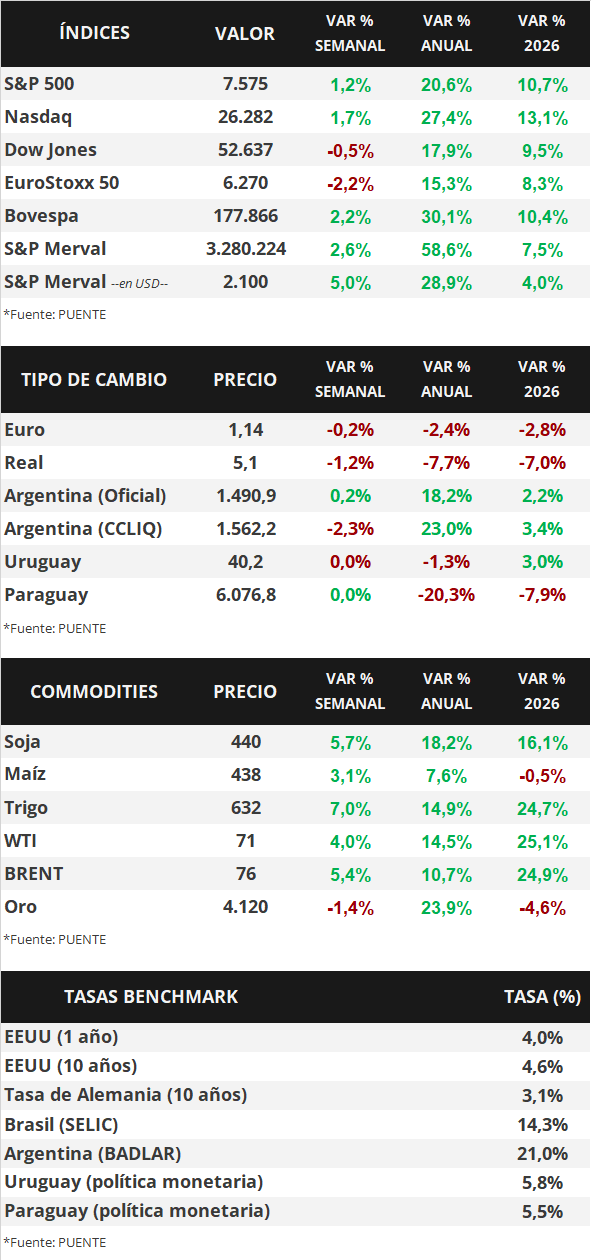
The minutes from the Federal Reserve's (Fed) June monetary policy meeting revealed divergences among committee members, with some supporting an increase in the benchmark interest rate due to heightened inflationary pressures, although it ultimately remained unchanged (currently at 3.75%). Against this backdrop, US Treasury yields widened during the week, primarily on the short end of the curve, with the 1-year Treasury yield reaching 4.05% and the 10-year Treasury yield 4.56%. This week, attention will be focused on the June retail inflation data, for which an annual increase of 3.8% is projected, and 2.9% for the core inflation measure (excluding food and fuel), as well as on the wholesale price index for the same month. Meanwhile, the second-quarter corporate earnings season is beginning, and financial sector companies will be reporting their results. In the short term, the outlook is for inflation above the Fed's target (+2.0%) and a stable labor market, so the monetary policy rate is expected to remain at historically high levels, as anticipated by the Fed. This allows for higher nominal returns for longer on investment-grade bonds, with maturities up to 5 years being particularly attractive.
Weekly Monitor
International
This week's focus in the United States will be on the release of the June Consumer Price Index (CPI), with expectations of a year-over-year increase of 3.8% and a 2.9% rise in core inflation. Other indicators, such as wholesale inflation, industrial production, and retail sales figures (a proxy for economic activity), will also be released for the same month. Meanwhile, with the second-quarter earnings season beginning, some financial companies will present their results. In the Eurozone, preliminary July inflation figures will also be released, with an estimated year-over-year increase of 2.8% and a 2.4% rise in core inflation. Finally, China's second-quarter GDP will be announced.
The minutes from the Fed's June meeting revealed that some members of the monetary policy committee supported an interest rate hike due to concerns about rising inflationary risks, although the rate ultimately remained unchanged at 3.75%. They also outlined two likely scenarios: one with moderate inflation, which would lead to maintaining the current interest rate or gradually reducing it, and another with high inflation, which would lead to a further tightening of monetary policy.
In this environment, US Treasury yields widened during the week, primarily on the short end of the curve. Consequently, the 1-year Treasury yield rose from 3.92% to 4.05%, the 3-year yield from 4.16% to 4.24%, and the 10-year yield from 4.48% to 4.56%. Meanwhile, investment-grade corporate bonds (LQD ETFs) finished with a yield of 5.7%. For their part, the main US stock indices were mostly positive, with the Nasdaq leading the way with a gain of 1.7%.
In the Eurozone, retail sales in May showed a monthly increase of 0.2% and a year-on-year increase of 1.6%, slightly above expectations. Meanwhile, wholesale prices for the same month rose 0.2% month-on-month and 5.9% year-on-year, accelerating for the third consecutive month and exceeding the projected 5.7% increase. Against this backdrop, the benchmark EuroStoxx 50 stock index fell 2.2% weekly, while the yield on the 10-year German Treasury bond rose to 3.07%.
In Latin America, June inflation figures were released for Brazil, Mexico, and Chile. In Brazil and Mexico, inflation slowed compared to the previous month and fell short of expectations, registering year-on-year increases of 4.6% and 3.4%, respectively; while in Chile, inflation reached 4.3%, exceeding expectations.