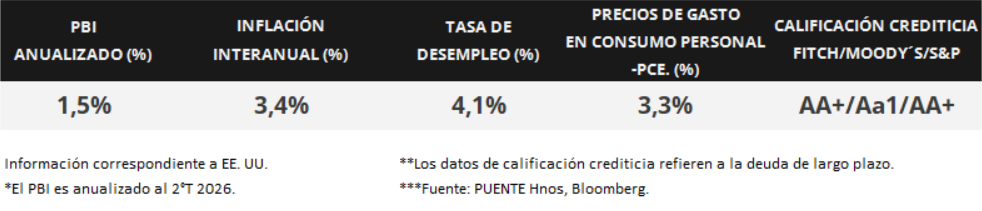
In the United States, the Consumer Price Index for July was in line with expectations, rising 3.4% year-over-year, and 2.5% year-over-year in the measure excluding food and energy (core), marking a slowdown for the second consecutive month. Meanwhile, wholesale inflation also slowed its pace of increases in July, registering 4.7% year-over-year and 4.2% year-over-year in core inflation. Against this backdrop, the S&P 500 stock index reached a new all-time high after rising 0.4% for the week, while US Treasury yields traded mixed, with the 1-year Treasury yield narrowing to 3.96% and the 10-year yield widening to 4.69%. This week, attention will be focused on the release of the minutes from the Federal Reserve's (Fed) latest monetary policy meeting and the preliminary August Purchasing Managers' Index (PMI) data—leading indicators of economic activity. In the short term, a scenario is expected with inflation above the Fed's target of 2.0% and a stable labor market, which would lead to the benchmark interest rate (currently at 3.75%) remaining at historically high levels. This allows for higher nominal returns for longer on investment-grade bonds, with maturities up to five years being particularly attractive.
Weekly Monitor
International
This week's focus in the United States will be on the minutes from the Fed's latest meeting, where it decided to keep the monetary policy rate unchanged at 3.75%. Also expected are the preliminary August PMIs (leading indicators of economic activity) and the July industrial production figures; meanwhile, the second-quarter corporate earnings season continues. In the Eurozone, final inflation figures for July will be released, with an estimated annual increase of 2.9% and a core inflation rate of 2.5%, along with preliminary August PMIs. In Latin America, Chile will publish its second-quarter Gross Domestic Product (GDP), with the latest figure showing a 0.5% year-on-year decrease.
In the United States, July retail inflation was in line with analysts' consensus expectations. Specifically, it advanced 0.1% month-on-month and 3.4% year-on-year, while core inflation rose 0.2% compared to June and 2.5% year-on-year. It is also important to note that year-on-year growth slowed for the second consecutive month.
On the other hand, the wholesale price index followed the downward trend, registering 4.7% year-on-year compared to the estimated 4.9%, and 4.2% for core inflation. Regarding activity, July retail sales fell 0.6% month-on-month, in contrast to the projected 0.1% increase, marking the first negative result in the last six months. Year-on-year, sales rose 5.0%, slowing for the second consecutive month.
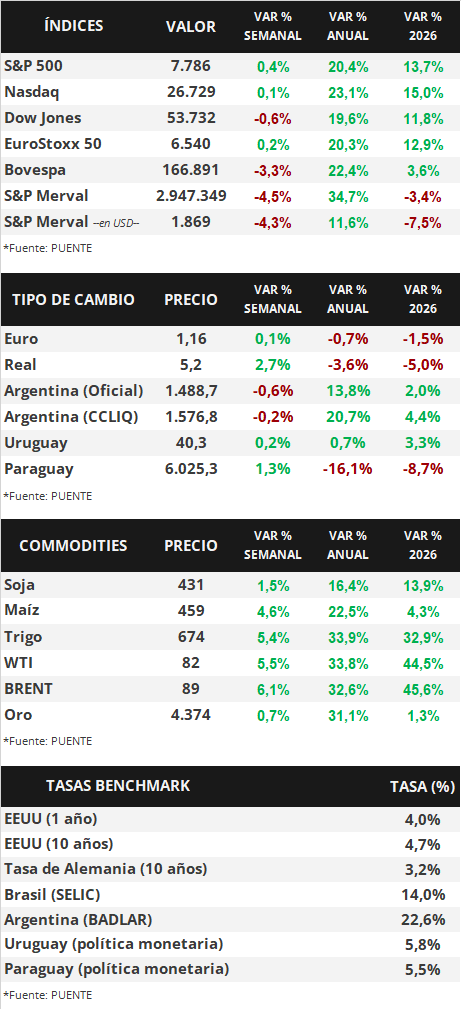
Against this backdrop, US Treasury yields showed mixed results across the yield curve during the week. Thus, the 1-year bond yield compressed from 3.99% to 3.96%, the 3-year yield from 4.26% to 4.24%, while the 10-year yield expanded from 4.65% to 4.69%. Meanwhile, investment-grade corporate bonds (LQD ETFs) closed with an average yield of 5.8%. Finally, the main US stock indices showed mixed performance, with the S&P 500 reaching a new all-time high after gaining 0.4% for the week, while the Dow Jones fell 0.6%.
On the geopolitical front, the stalemate in diplomatic negotiations between the United States and Iran, coupled with increased pressure from Washington to reopen the Strait of Hormuz and projections of supply deficits for the remainder of this year and next due to the prolonged conflict, once again put downward pressure on prices. Thus, Brent crude rose 6.1% weekly and WTI crude climbed 5.5% to $88.6 and $82.5 per barrel, respectively.
In the Eurozone, second-quarter GDP grew 0.4% quarter-on-quarter and 1.0% year-on-year, according to the second estimate, surpassing the performance of the first quarter. Meanwhile, industrial production in June showed no change month-on-month and expanded 0.1% year-on-year, in contrast to forecasts (-0.1% and -0.8% respectively). For the week, the EuroStoxx 50 stock index rose 0.2%.
On the other hand, in Brazil, July inflation registered a monthly increase of 0.1% and a year-on-year increase of 4.4%, in line with analysts' consensus projections. It is important to note that the annual figure slowed its pace of increases for the third consecutive month, despite the Central Bank's recent reduction of the monetary policy rate (to 14%). Consequently, the real rose 2.7% week-on-week to 5.2 reais per dollar.