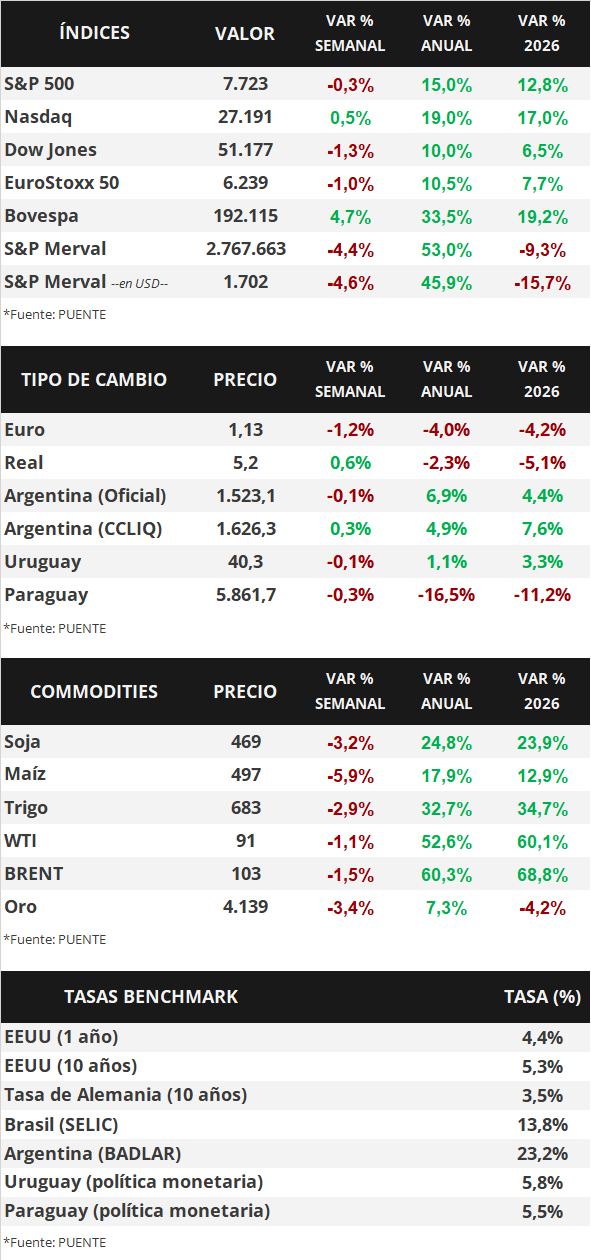
In the United States, 29,000 jobs were created in September—a figure below the 88,000 jobs estimated and the revised August figure of 133,000. Meanwhile, the unemployment rate stood at 4.2%, exceeding expectations. Separately, the Personal Consumption Expenditures (PCE) price index for August—the Federal Reserve's (Fed) benchmark for monetary policy decisions—was released; the core measure (excluding food and energy) rose by 3.0%, coming in below estimates. Meanwhile, second-quarter Gross Domestic Product (GDP) grew at an annualized rate of 2.2%, surpassing the consensus forecast among analysts. Against this backdrop, the U.S. Treasury yield curve steepened across most maturities during the week, with the 1-year bond holding steady at 4.45% and the 10-year bond reaching 5.27%. This week, the focus will be on the minutes from the Fed's latest monetary policy meeting and the release of August trade balance data. In the short term, the outlook points to inflation remaining above the central bank's 2.0% target alongside a resilient labor market, factors likely to keep interest rates at historically high levels. This environment allows for sustained high nominal yields on investment-grade bonds, with the curve segments of up to five years in duration appearing particularly attractive.
Weekly Monitor
International
Attention in the United States this week will focus on the release of the minutes from the Fed's September monetary policy meeting, during which the benchmark rate was raised to the 3.75%–4.00% range. August trade balance figures will also be released, while anticipation remains regarding a potential agreement between the United States and Iran. In the Eurozone, data on August retail sales—a proxy indicator for economic activity—will be published. Finally, in Latin America, September inflation figures will be announced for Brazil, Mexico, and Chile. Annual increases of 4.5% and 3.4% are expected for the first two, respectively, while the latest figure for Chile stands at 4.1% year-over-year.
In the United States, 29,000 jobs were created in September, a figure below both the projected 88,000 jobs and the revised August figure (133,000 jobs). Meanwhile, the unemployment rate stood at 4.2%, slightly above the 4.1% estimated by the analyst consensus and recorded over the previous two months.
Additionally, August PCE inflation—the Fed's preferred indicator for monetary policy decisions—came in lower than projected across the board. It recorded a monthly rise of 0.3% and an annual increase of 3.4%, while the core measure rose 0.2% monthly and 3.0% annually (versus an estimated 3.3%). Regarding economic activity, second-quarter GDP grew by an annualized 2.2% according to the final estimate; this exceeded the 1.5% expected by the analyst consensus, though it was slightly lower than the revised performance of the first quarter (annualized 2.5%).
Against this backdrop, US Treasury bond yields widened across most maturities. While the 1-year bond yield held steady at 4.45%, the 3-year yield rose from 4.93% to 4.95%, and the 10-year benchmark climbed from 5.16% to 5.27%, hitting highs not seen since 2002 during the week. Meanwhile, investment-grade corporate bonds (LQD ETF) closed with an average yield of 6.4%. Elsewhere, major US stock indices showed mixed performance, with the Nasdaq standing out by posting a weekly gain of 0.5%.
In Brazil's presidential election, Liberal Party candidate Flavio Bolsonaro defeated Lula da Silva—the incumbent president and Workers' Party representative—by a margin of less than 2 percentage points. Following this narrow result, the two will face off again in a runoff election on October 25 to determine the next president.
In the Eurozone, preliminary inflation figures for September accelerated across most metrics. Specifically, the headline rate rose 0.6% month-on-month and 3.8% year-on-year—surpassing the forecast of 3.7%—while core inflation registered a 0.2% monthly increase and a 2.5% year-on-year rise. Against this backdrop, the euro fell 1.2% over the week to 1.13 dollars, while the yield on the 10-year German government bond ended the week at 3.46%.