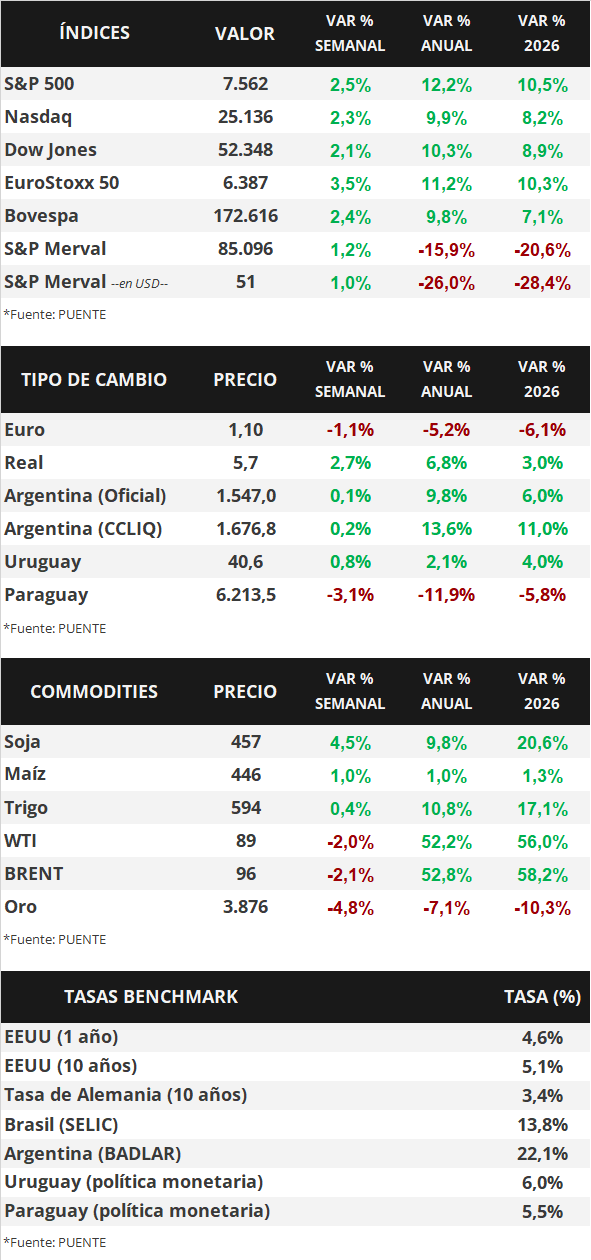
In the United States, the Consumer Price Index (CPI) for October came in slightly above expectations, showing a monthly increase of 0.4%, and 0.3% when excluding food and energy (core CPI). It should be noted that year-over-year figures were not released due to a lack of data for that month in 2025, resulting from a federal government shutdown. Meanwhile, wholesale inflation for the period reached 6.5% year-over-year—accelerating for the third consecutive month—with core wholesale inflation at 5.0%. Against this backdrop, the U.S. Treasury yield curve steepened across the board during the week, with the 1-year Treasury note at 4.61% and the 10-year note at 5.14%. This week, the minutes from the Federal Reserve’s October meeting will be released, alongside data on economic activity, such as retail sales and industrial production for October. Additionally, Nvidia—one of the "Magnificent Seven"—is expected to report its third-quarter earnings. Looking ahead, the outlook suggests inflation will remain above the Federal Reserve’s long-term target of 2.0%, coupled with a resilient labor market; this is likely to keep interest rates at historically high levels. Consequently, investment-grade bonds may continue to offer high nominal yields for an extended period, with the portion of the yield curve covering maturities of up to five years appearing particularly attractive.
Weekly Monitor
International
In the United States, the focus this week will be on the release of the minutes from the Federal Reserve’s October monetary policy meeting. Additionally, data on retail sales—a proxy for economic activity—and industrial production for October will be released, with monthly increases of 0.2% and 0.1% projected, respectively. Regarding the third-quarter corporate earnings season, Nvidia—one of the "Magnificent Seven"—is set to report its results. In the Eurozone, October inflation figures are expected, with a projected annual increase of 4.0% (2.5% for the core measure), alongside data on September industrial production. Finally, in Latin America, Chile will release its third-quarter Gross Domestic Product (GDP) figures; the previous reading showed a 0.2% annual decline.
In the United States, October inflation came in slightly above expectations, rising 0.4% on a monthly basis, with the core measure increasing by 0.3%. It is worth noting that year-over-year figures were not published, as the federal government shutdown last year prevented data collection for that month.
Meanwhile, wholesale inflation for October rose 0.3% month-over-month and 6.5% year-over-year—both figures falling below projections. The core measure rose 0.3% from September and 5.0% year-over-year, in line with expectations.
Against this backdrop, U.S. Treasury yields rose over the week, particularly along the short and intermediate segments of the yield curve. The 1-year Treasury yield moved from 4.31% to 4.61%, the 3-year yield from 4.58% to 4.92%, and the 10-year benchmark yield from 4.86% to 5.14%. Meanwhile, investment-grade corporate bonds (ETF LQD) closed with an average yield of 6.3%. Elsewhere, major U.S. stock indices saw broad-based gains, with the S&P 500 and the Nasdaq rising by 2.5% and 2.3%, respectively.
In Latin America, October inflation data was released for Brazil and Mexico. In Brazil, the annual inflation rate reached 4.6%—lower than the consensus forecast among analysts, yet an increase compared to September’s figures. In Mexico, inflation accelerated for the third consecutive month, reaching an annual rate of 3.75%, which exceeded expectations. Consequently, exchange rates for the week showed a 2.7% increase in Brazil, while the Mexican peso saw a 0.5% decline.