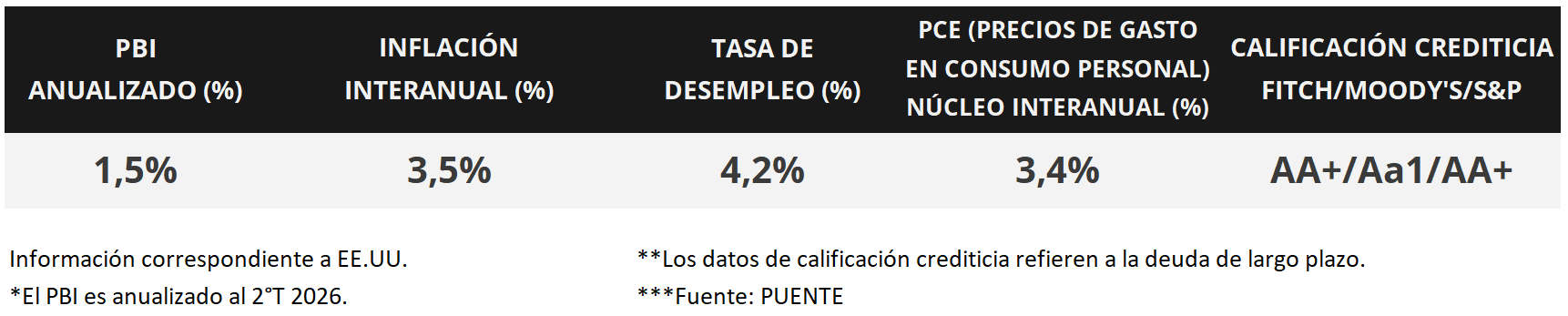
The Federal Reserve (Fed) kept its benchmark interest rate unchanged in the current range of 3.5%-3.75%, in line with expectations, considering that inflationary pressures persist. In this context, the June Personal Consumption Expenditures (PCE) price index—a key inflation indicator for monetary policy decisions—was released, registering a 3.3% increase in the core inflation measure (excluding food and energy). Meanwhile, the second-quarter Gross Domestic Product (GDP) figures were published, showing growth at an annualized rate of 1.5%, lower than the previous quarter's figure and the 2.0% estimated by analysts. Against this backdrop, US Treasury yields traded mixed, with the 1-year Treasury yield falling to 4.04% and the 10-year yield rising to 4.71%. This week, attention will be focused on the evolution of the labor market in July, with an estimated 90,000 new jobs created and an unemployment rate of 4.3%. Meanwhile, the second-quarter earnings season continues. The short-term outlook features inflation above the central bank's target of 2.0% and a stable labor market, which is keeping interest rates at historically high levels. This allows for higher nominal returns for longer periods on investment-grade bonds, with maturities up to five years being particularly attractive.
Weekly Monitor
International
This week's focus in the United States will be on the evolution of the labor market in July, with an estimated 90,000 new jobs created and an unemployment rate of 4.3%. The June trade balance will also be released, while the second-quarter corporate earnings season continues. In the Eurozone, June retail sales figures—a proxy indicator of economic activity—will be published. In Latin America, monetary policy meetings will be held in Brazil and Mexico. Brazil is projected to lower its rate to 14.0% from the current 14.25%, while Mexico is expected to keep its rate unchanged at 6.5%. Finally, July inflation figures will be released in Mexico and Chile, with the latest figures showing year-on-year increases of 3.4% and 4.3%, respectively.
The Fed kept its policy rate unchanged in the 3.5%-3.75% range, in line with expectations. The decision revealed dissent, with some committee members voting for an increase in borrowing costs in response to rising inflationary pressures. The Fed also stated that economic activity continues to grow at a solid pace and the labor market remains stable, despite uncertainty surrounding the conflict in the Middle East.
Meanwhile, PCE inflation—the Fed's benchmark for interest rate decisions—slowed in June, in line with analysts' consensus estimates in most measurements. Specifically, it registered -0.1% month-on-month and +3.7% year-on-year, while core inflation rose +0.1% month-on-month and +3.3% year-on-year.
Regarding economic activity, Q2 GDP registered annualized growth of 1.5%, according to preliminary estimates, slowing compared to the previous period and falling short of analysts' projections of 2.0%.
With Q2 earnings season underway, last week saw earnings per share (EPS) and revenue reports exceeding expectations from companies such as Amazon, Apple, Microsoft, Coca-Cola, Visa, Mastercard, and Starbucks. Procter & Gamble, on the other hand, reported higher-than-expected EPS but lower-than-expected revenue, while Meta Platforms, AbbVie, and Barclays only surpassed their revenue projections. This week, reports are expected from Caterpillar, Palantir, Merck & Co., McDonald's, Pfizer, Booking.com, Eli Lilly, Walt Disney, CVS Health, MercadoLibre, Glencore, Airbnb, and Allianz, among others.
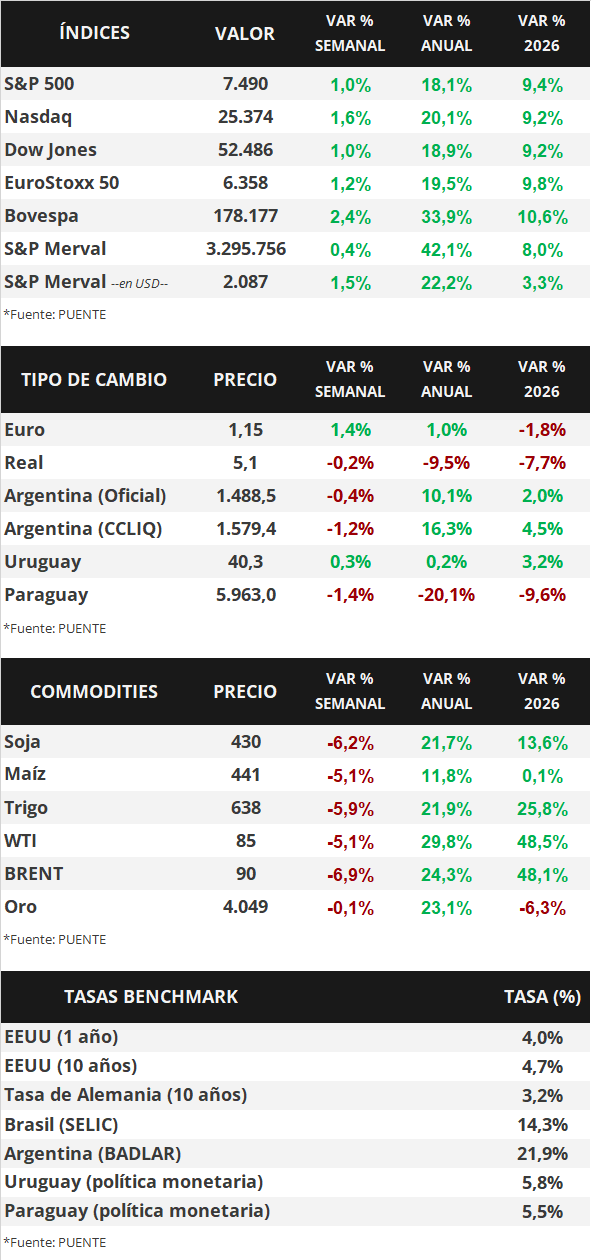
In this environment, US Treasury yields showed mixed performance during the week. While the 1-year bond yield compressed from 4.11% to 4.04% and the 3-year yield fell from 4.37% to 4.33%, the 10-year yield expanded from 4.68% to 4.71%. Meanwhile, investment-grade corporate bonds (LQD ETFs) finished with a yield of 5.9%. Finally, the main US stock indices closed positive, with the Nasdaq leading the way with a weekly gain of 1.6%.
In the Eurozone, second-quarter GDP expanded by 1.0% year-on-year and 0.4% quarter-on-quarter, exceeding analysts' consensus estimates (0.7% and 0.2%, respectively). On the other hand, preliminary inflation for July accelerated compared to June, registering 2.9% year-on-year and 2.5% core inflation, slightly above expectations. Against this backdrop, the euro closed at $1.15 after rising 1.4% for the week, while the yield on the 10-year German Treasury bond climbed to 3.21%.
Globally, monetary policy meetings were also held in England, Japan, and Chile. The Bank of England kept its benchmark interest rate unchanged at 3.75%, a trend mirrored by the Bank of Japan and the Central Bank of Chile, whose interest rates remained unchanged at 1.0% and 4.5%, respectively.