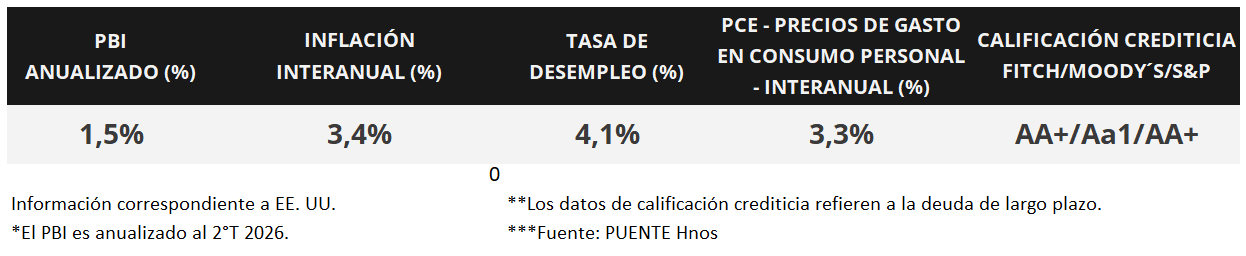
The U.S. Federal Reserve (Fed) raised the interest rate by a quarter of a percentage point to the 3.75%–4.00% range, in line with expectations. In terms of monetary policy, interest rates are expected to be higher than anticipated a few months ago, with the projection for 2026 standing at 4.1%, which would imply another increase before the end of the year. In terms of the outlook, growth projections were raised (+2.3%) as were projections for PCE inflation (which measures household personal consumption expenditures and is the Fed’s preferred indicator for monetary policy decisions: +3.4% annually for the core measure, excluding food and energy), while the unemployment estimate was lowered (4.1%). In this environment, the U.S. Treasury yield curve widened across the board during the week, with the 1-year Treasury note yielding 4.4% and the benchmark 10-year Treasury note reaching 5.0%, its highest level in nearly two decades. This week, attention will focus on the release of preliminary data for the sector-specific Purchasing Managers’ Indexes (PMIs)—leading indicators of economic activity—for September. At the same time, expectations remain high for a potential agreement to end the conflict in the Middle East. The short-term outlook shows inflation remaining above the central bank’s target (2.0%) and a resilient labor market, which would keep interest rates at historically high levels. This allows for higher nominal yields on investment-grade bonds for a longer period, making segments of the yield curve with maturities of up to 5 years attractive.
Weekly Monitor
International
This week in the United States, attention will focus on the release of preliminary September sectoral PMI data—leading indicators of economic activity—and the University of Michigan’s September inflation expectations survey, which is estimated at +4.6% for the next 12 months. In the Eurozone, the September sectoral PMIs will also be released; meanwhile, in Latin America, the Central Bank of Mexico will hold a monetary policy meeting, with expectations that it will keep the interest rate unchanged at the current 6.5%.
The Fed decided to raise the benchmark interest rate by a quarter of a percentage point to the current range of 3.75%–4.00%, for the first time since 2023. The decision, which was unanimous and in line with expectations, was based on a scenario in which economic activity is growing at a solid pace, despite geopolitical uncertainty, with the labor market keeping pace with this trend. Meanwhile, inflation remains persistent and continues to exceed the long-term target of 2.0%.
In its quarterly update of macroeconomic projections, the growth forecast for 2026 was raised to +2.3% annually, and the inflation forecast: overall PCE is expected to be +3.7% year-over-year, up from the previous +3.6%, while the PCE excluding food and energy (core) is projected at +3.4%, up from +3.3% in June. Meanwhile, the unemployment projection was lowered to 4.1%. In terms of monetary policy, the outlook is more restrictive than in June, with the benchmark rate expected to end 2026 at around 4.1%, which would imply another increase for the remainder of the year. The restrictive stance is expected to continue throughout 2027.
Meanwhile, August retail sales figures—a proxy indicator of economic activity—were released, showing a +1.2% increase month-over-month and a +1.4% increase year-over-year, exceeding both analysts’ consensus forecasts and July’s figures. Industrial production, however, remained unchanged month-over-month, while posting a +1.4% year-over-year increase.
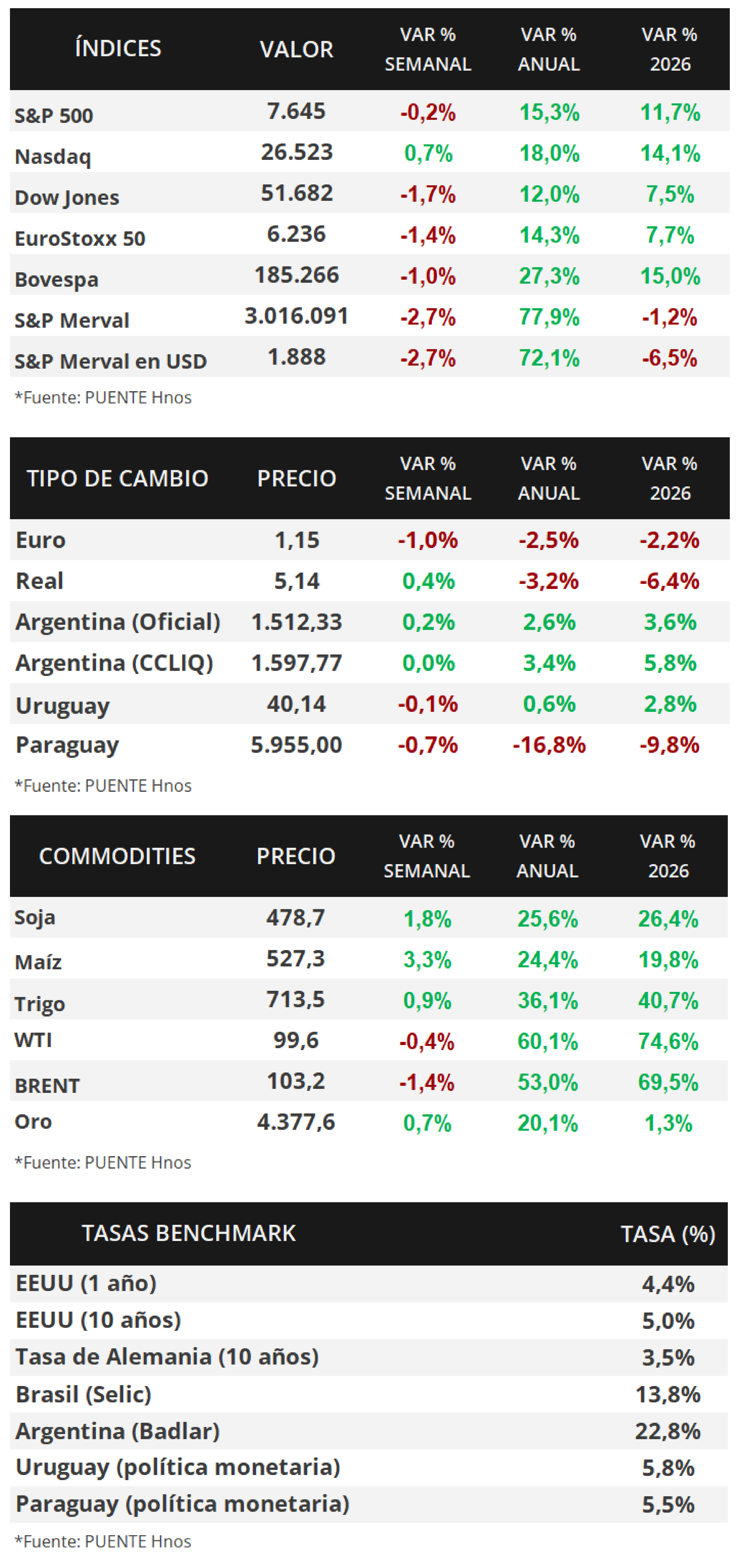
Against this backdrop, yields on U.S. Treasury futures rose during the week, primarily at the short and medium ends of the yield curve. Thus, the 1-year bond yield rose from 4.32% to 4.40%, the 3-year yield from 4.72% to 4.84%, and the benchmark 10-year yield from 4.97% to 5.0%, with the latter reaching levels last seen in 2007. Meanwhile, investment-grade corporate bonds (LQD ETF) posted an average yield of 6.0%. Elsewhere, the major U.S. stock indices closed mixed, with the Nasdaq standing out with a weekly gain of 0.7%.
In the Eurozone, inflation in August showed a slight acceleration compared to July, coming in at +0.4% month-over-month and +3.2% year-over-year, versus the expected +3.3%. Meanwhile, core inflation rose by +0.2% from July and +2.4% year-over-year. Against this backdrop, the euro fell by -1.0% for the week to $1.15 per euro, while the yield on the 10-year German government bond rose slightly to 3.52%.
Globally, there were also monetary policy meetings in the United Kingdom, Japan, and Brazil. While the Bank of England kept its benchmark rate unchanged at 3.75% annually, Japan implemented a new increase in the cost of borrowing, raising it to 1.25% from 1.0%. In contrast to these stances, the Central Bank of Brazil continues to ease monetary policy, cutting the interest rate for the fifth time this year, bringing it down to 13.75% from the previous 14%.