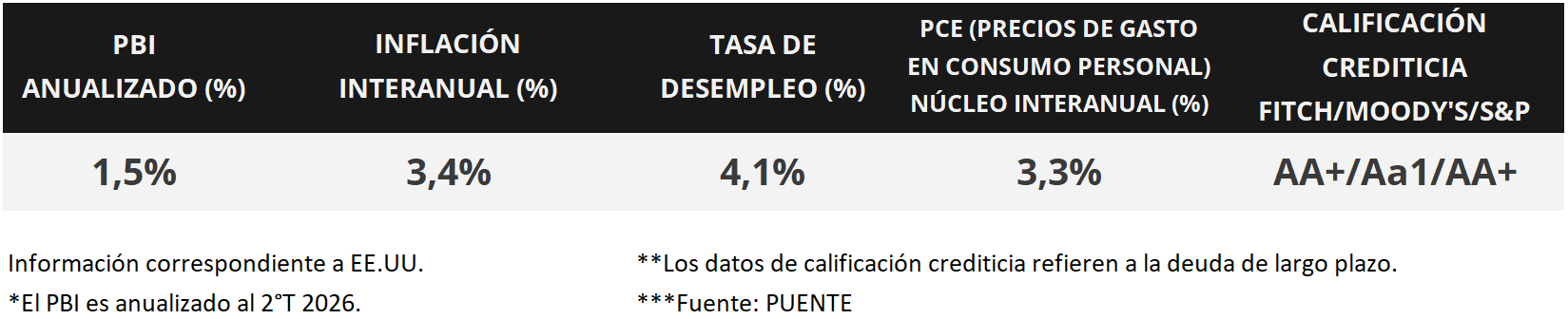
In the United States, sectoral Purchasing Managers' Indexes (PMIs)—leading indicators of activity—for September exceeded expectations across the board, with manufacturing registering 57 points. Against this backdrop, the U.S. Treasury yield curve steepened broadly during the week; the 1-year bond yield stood at 4.45%, while the 10-year bond reached 5.17%, its highest level since 2007. Attention this week will focus on the release of August data for the Personal Consumption Expenditures (PCE) price index—the Federal Reserve's (Fed) preferred gauge for monetary policy decisions—with expectations of a 3.7% annual increase, or 3.4% for the core measure (excluding food and energy). Additionally, September labor market data will be released, with estimates pointing to the creation of 100,000 new jobs and an unemployment rate holding steady at 4.1%, alongside the final second-quarter Gross Domestic Product (GDP) projection, forecast at an annualized 1.5%. The short-term outlook features inflation remaining above the Fed's 2.0% target and a resilient labor market, factors likely to keep interest rates at historically high levels. This environment allows for sustained high nominal yields on investment-grade bonds, making the curve segments with maturities of up to five years particularly attractive.
Weekly Monitor
International
This week, attention in the United States will focus on the Fed's monetary policy meeting; the benchmark rate is expected to remain unchanged within the current 3.5%–3.75% range. The central bank will also present its quarterly update on economic outlooks and the projected interest rate path. Additionally, data on retail sales—a proxy for economic activity—and industrial production for August will be released. In Europe, final inflation figures for the Eurozone for August will be published, with a year-on-year rise of 3.3% (headline) and 2.4% (core) anticipated. Monetary policy meetings are also scheduled in other countries. In the UK, borrowing costs are expected to remain unchanged at an annual 3.75%; in Japan, a tightening of monetary policy is anticipated, with a rate hike to 1.25% from the current 1.0%; meanwhile, in Brazil, a further easing of the Selic rate to 13.75% from the current 14% is expected.
This week, attention in the United States will center on the release of September labor market data; forecasts point to the creation of 100,000 new jobs and an unemployment rate of 4.1%. August PCE inflation—the Fed's benchmark for interest rate decisions—will also be released, with a projected annual increase of 3.7% (headline) and 3.4% (core). Finally, the final estimate of second-quarter GDP will be announced, with growth expected at an annualized rate of 1.5%. In the Eurozone, preliminary inflation data for September will be published, with a projected annual increase of 3.5% (headline) and 2.6% (core). In the United States, preliminary PMI data—leading indicators of economic activity—for September significantly exceeded expectations, accelerating across all sectors compared to August figures. The manufacturing PMI came in at 57 points, while the services PMI stood at 58.7 points. It is worth noting that a reading above 50 points indicates expansion, whereas a reading below that threshold signals a contraction in activity.
Meanwhile, the University of Michigan’s inflation expectations survey for September stood at +4.6% for the coming 12 months, aligning with the analyst consensus forecast. This figure represents an acceleration compared to expectations in August.
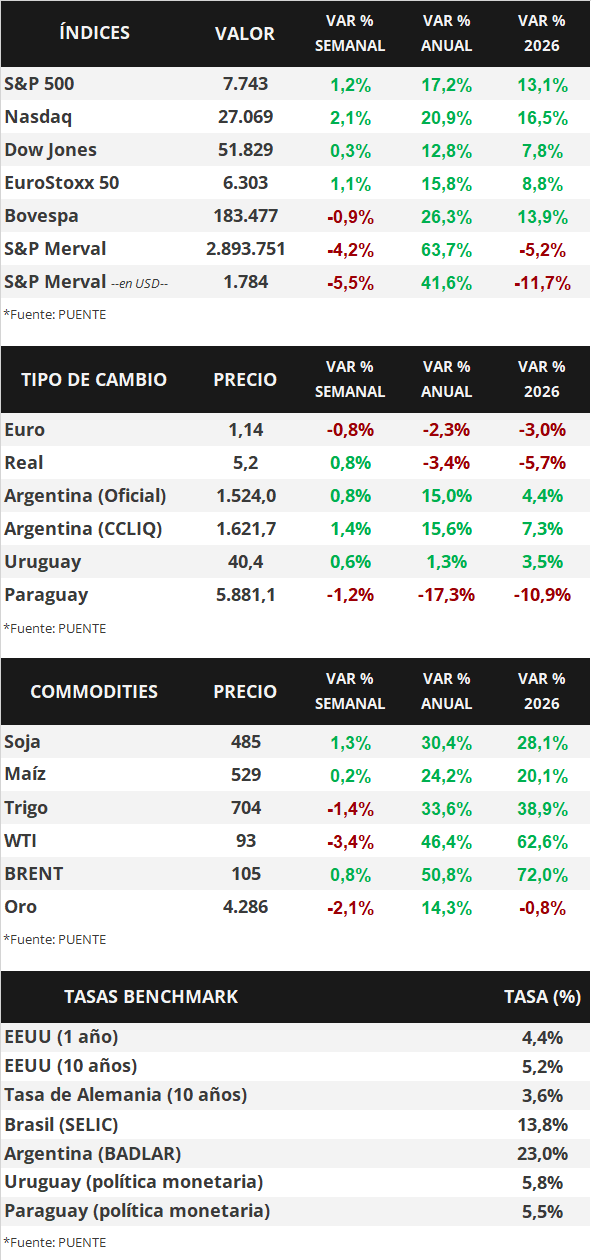
Against this backdrop, US Treasury yields rose over the week, particularly along the intermediate segments of the yield curve. The 1-year bond yield moved from 4.40% to 4.45%, the 3-year yield from 4.84% to 4.94%, and the benchmark 10-year yield from 5.0% to 5.17%—the highest level since June 2007. Investment-grade corporate bonds (LQD ETF) closed with an average yield of 6.3%. Separately, major US stock indices ended the week in positive territory, with the Nasdaq leading the trend with a +2.1% gain.
Sectoral PMI data for September were also released for the Eurozone, exceeding analyst consensus forecasts in every instance. Specifically, the manufacturing PMI stood at 52.7 points, while the services and composite PMIs recorded 53 and 53.1 points, respectively, marking an improvement over August. Against this backdrop, the EuroStoxx 50 stock index rose 1.1% over the week.
In Latin America, the Central Bank of Mexico held its monetary policy meeting, keeping the benchmark interest rate unchanged at 6.5% per annum, in line with the consensus forecast among analysts. Amidst this, the exchange rate rose 2.6% during the week.